The Hidden Tax on Retirees: IRMAA
The Hidden Tax On Retirees: IRMAA
Quick Summary: IRMAA (the Income-Related Monthly Adjustment Amount) is a Medicare surcharge that raises Part B and Part D premiums for those whose income exceeds set thresholds and is based on tax returns filed two years earlier. For 2026, retirees can pay Medicare premiums up to $689.90/month for Part B, more than triple the standard $202.90 rate, once income crosses into the top tier. Because IRMAA is based on Modified Adjusted Gross Income (MAGI), any increase in reportable income (think capital gains from rebalancing a portfolio, required minimum distributions, a Roth conversion, or a one-time event like a home sale) can push a retiree into a higher bracket without warning. This guide explains how IRMAA is calculated, the income events retirees should watch most closely, including how to plan Roth conversions carefully, to avoid an unexpected Medicare surcharge two years down the road.
Why Roth Conversions Deserve a Second Look
For retirees, Roth conversions are one of the most useful tax planning tools available and one of the easiest ways to accidentally trigger IRMAA, the Income-Related Monthly Adjustment Amount, a hidden tax in retirement that raises Medicare Part B and Part D premiums for two full years after the fact. In 2026, a retiree crossing just $1 into the first IRMAA tier pays an extra $974 a year for Medicare Part B alone. Because Medicare bases this year's premium on income reported two years ago, a Roth conversion done today without checking it against the IRMAA brackets can quietly set a retiree's 2028 Medicare bill. This guide covers what IRMAA is, how it's calculated, what Medicare Part B covers, and how retirees can plan Roth conversions with IRMAA in mind.
IRMAA Looks Back Two Full Years
The single most misunderstood feature of IRMAA is timing. The premium a retiree pays this year is not based on this year's income… it's based on the tax return filed two years earlier. A retiree's 2026 Medicare premium is determined by the MAGI reported on the 2024 tax return; 2027 premiums will be set by 2025 MAGI, and so on. The Social Security Administration uses this lag because a two-year-old tax return is the most recent complete income data the IRS can provide, and this is what makes IRMAA feel like a hidden tax: the income event and the higher Medicare bill it causes are separated by two years, long enough that the connection is easy to miss.
How MAGI Is Calculated for IRMAA
MAGI for IRMAA purposes is simpler than the several other "MAGI" definitions used elsewhere in the tax code (IRA deduction limits, Roth contribution eligibility, and Premium Tax Credit calculations each use different add-backs). For IRMAA, the formula is:
IRMAA MAGI = Adjusted Gross Income (AGI) + Tax-Exempt Interest
AGI is total income, less the above-the-line deductions allowed. For retirees, this typically includes maybe part-time work or consulting income, taxable interest and dividends, capital gains (including gains from rebalancing), traditional IRA/401(k) distributions and RMDs, the full amount of any Roth conversion (included in gross income), pension income, rental/business income, and the taxable portion of Social Security.
The add-back: tax-exempt interest which most commonly is municipal bond interest, and is excluded from income for regular tax purposes but added back for IRMAA.
We call IRMAA a hidden tax in retirement because it doesn't show up on a 1040 the way ordinary tax does. It shows up two years later, as a line item deducted from a Social Security check or billed directly by Medicare. Many retirees never connect a profitable year of investment rebalancing or a Roth conversion to the higher Medicare premium that follows until the notice arrives.
Two features make IRMAA especially punishing for financial planning purposes:
The two-year lookback. As detailed above, this year's Medicare premium reflects income reported two tax years earlier — a timing gap that separates the decision from the consequence.
The cliff structure. IRMAA does not phase in gradually. Exceed a MAGI threshold by even one dollar, and the full surcharge for that tier applies for the entire year, to BOTH spouses, if both are enrolled in Medicare.
What IRMAA Impacts: Medicare Part B and Part D
IRMAA applies to two parts of Medicare: Part B (medical insurance), where the surcharge is added directly to the monthly premium, and Part D (prescription drug coverage), where it's billed separately by Medicare on top of your plan's own premium. Part A (hospital insurance) and Medigap policies are not subject to IRMAA.
What Does Medicare Part B Actually Cover?
Because Part B carries the larger and more visible IRMAA surcharge, it's worth understanding what the premium buys. Medicare Part B covers medically necessary outpatient services and preventive care, including:
Physician visits and outpatient specialist care
Preventive services such as annual wellness visits, screenings, and vaccines
Durable medical equipment (wheelchairs, oxygen equipment, walkers)
Outpatient mental health services
Ambulance services and outpatient hospital/ER care
Certain home health services
For 2026, the standard Part B premium is $202.90 per month. Retirees who exceed the IRMAA income thresholds pay this standard amount plus a surcharge that scales across five tiers.
The 2026 IRMAA Brackets: Standard, 1.4x, 2x, 2.6x, 3.2x and 3.4x
The table below shows the 2026 IRMAA tiers based on 2024 MAGI — the two-year lookback in action. Amounts are per person; a married couple where both spouses are on Medicare pays these amounts twice.
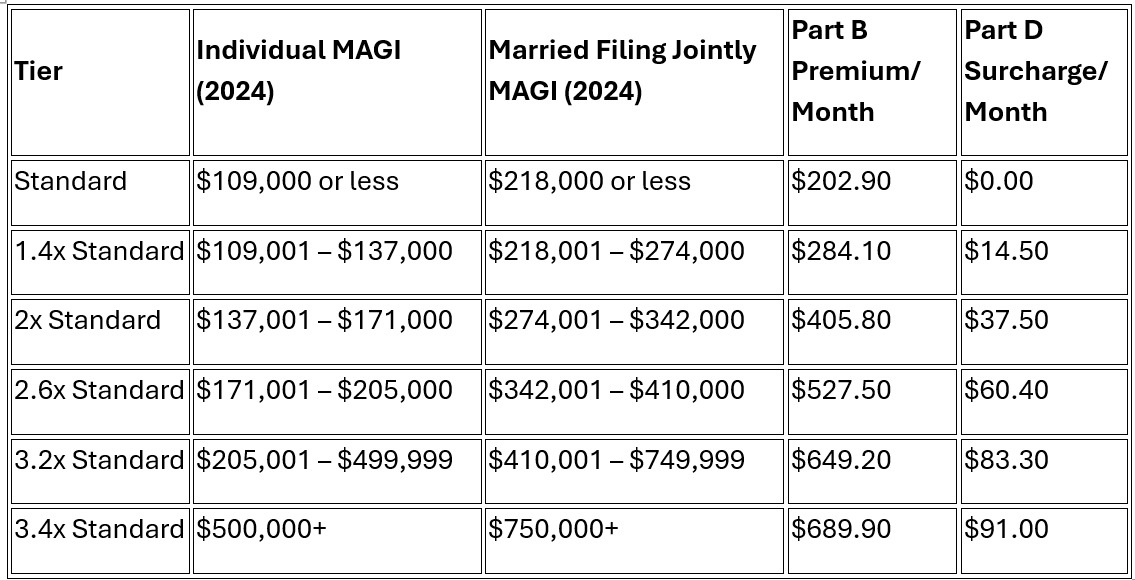
IRMAA Brackets.
At the top tier, a single retiree pays $689.90/month for Part B — roughly $8,279 a year, more than triple the standard premium, plus a $91.00 monthly Part D surcharge. For a married couple where both spouses are enrolled, these figures apply to each spouse separately, meaning the household impact doubles.
Roth Conversions and IRMAA: What Retirees Need to Watch
Roth conversions are one of the most valuable planning tools available to retirees. Moving money out of a traditional IRA and into a Roth IRA reduces future required minimum distributions, creates tax-free growth, and gives retirees more control over their tax picture for the rest of their lives. But a Roth conversion is taxed as ordinary income in the year of conversion, and the full converted amount counts toward MAGI, the same measure IRMAA uses. That makes Roth conversions one of the most common, and unlike most IRMAA triggers, one of the most controllable causes of an IRMAA surcharge.
Here's why retirees need to be careful:
The size of the conversion is a choice. Unlike an RMD or Social Security benefit, a retiree decides exactly how much to convert. The IRMAA impact is almost entirely avoidable with the right planning.
The two-year lookback hides the consequence. A retiree who converts a large amount in 2026 won't see the higher premium until 2028, by which point the conversion can't be undone.
"Filling the bracket" isn't "filling the tier." Converting to use up a tax bracket is sound tax planning, but the IRMAA brackets sit at different income levels and can be crossed before the next marginal tax rate applies.
The core planning discipline: before finalizing the size of any Roth conversion, retirees (and their advisors) should check the resulting MAGI against the IRMAA tables. This is especially important in the years just before and during Medicare enrollment, since the lookback means income reported at age 63 already shapes the Medicare premium at age 65.
Other Income Events That Trigger IRMAA in Retirement
Beyond Roth conversions, several other income events commonly push retirees into a higher IRMAA bracket:
Rebalancing and realizing capital gains. Selling appreciated investments adds the realized gain to MAGI in the year of sale, even if proceeds are reinvested. A large rebalancing year without offsetting tax-loss harvesting can be enough to cross an IRMAA threshold two years later.
Required Minimum Distributions (RMDs). RMDs from traditional IRAs and pre-tax employer plans generally begin at age 73 (based on date of birth) and count fully as ordinary income, sometimes pushing retirees into higher IRMAA tiers as account balances grow.
One-time income spikes. A home sale gain or a lump-sum pension distribution can cause a single-year MAGI spike that surfaces as an IRMAA surcharge two years out.
Social Security and pension income. Considering starting Social Security this year? Or maybe turning on pension income this year? These are considered taxable income and should be considered in your analysis.
Planning Strategies Retirees Can Use to Manage IRMAA
Model every Roth conversion against the IRMAA tiers — the single highest-leverage step, since conversion size is fully within the retiree's control.
Use qualified charitable distributions (QCDs). QCDs let IRA owners age 70½+ direct funds to charity, satisfying RMDs and do not increase your income.
Harvest gains strategically. Pair capital gains with tax-loss harvesting where possible to offset the MAGI impact of rebalancing.
Plan two years ahead, not just for the current tax bill, since this year's income sets a Medicare premium two years out.
Know the appeal process. Form SSA-44 lets retirees request a recalculation after certain life-changing events such as retirement, marriage, divorce, or death of a spouse. A capital gain, home sale, or Roth conversion does not qualify; those must be planned around in advance.
The Bottom Line for Retirees
IRMAA earns its reputation as a hidden tax in retirement because it operates quietly, on a two-year delay, and in cliff-like steps. Roth conversions deserve special attention: they're one of the most valuable tools available to retirees, and one of the easiest to size incorrectly if IRMAA isn't part of the calculation. The goal isn't to avoid conversions, capital gains, or RMDs but to coordinate the timing and size of each against the IRMAA brackets, years before the premium notice arrives. A coordinated CPA and financial advisor review of a retiree's Roth conversion strategy, ideally starting before Medicare enrollment, is the most reliable way to capture the benefit of a conversion without a Medicare surprise two years later.
Need some guidance?
If you’d like help evaluating your specific situation, click “Get Started”.
The financial and tax information offered by the advisor is general in nature. It is provided for informational purposes only and should not be construed as legal or tax advice. Always consult an attorney or tax professional regarding your specific legal or tax situation.
This article is for general educational purposes and does not constitute individualized tax or investment advice. Please consult a qualified CPA or CFP® professional regarding your specific situation.